
Modelling Energy Systems is More Important Than Ever – Here’s How to Understand It
Sub head
What is the best place to build a wind farm? Where should energy storage be located? And what are the best policies to tackle climate change? These are just a handful of questions that might require modelling energy supply, demand, and market arrangements. From individual houses to the whole planet, energy modelling is now more important than ever. Read our guide to the different types of energy models below to discover why scientists’ work is vital for both public authorities and businesses.
Media
Image
Content
With the recent decision to retain a single national wholesale electricity price, the United Kingdom is entering a new phase of the energy transition: “We have never planned the energy system in this country in the way we’re looking to do so now. The success of the energy transition is increasingly dependent on how well we do this. That’s why energy modelling is more important than ever before,” explains Dr Andrew Lyden, an energy modelling expert at the University of Edinburgh. Building a resilient, decarbonised energy system – one in which power plants and centres of electricity demand are optimally located – requires either market mechanisms that reflect local supply and demand or substantial planning and policy incentives. “We can model different planning options, market arrangements, how to operate the system, and where the best place to invest is,” explains Dr Lyden, who designed PyPSA-GB, a complex model of the UK electricity system that has proven useful to major stakeholders, including Octopus Energy, the Scottish Government, and members of the National Energy Systems Operator (NESO) team.
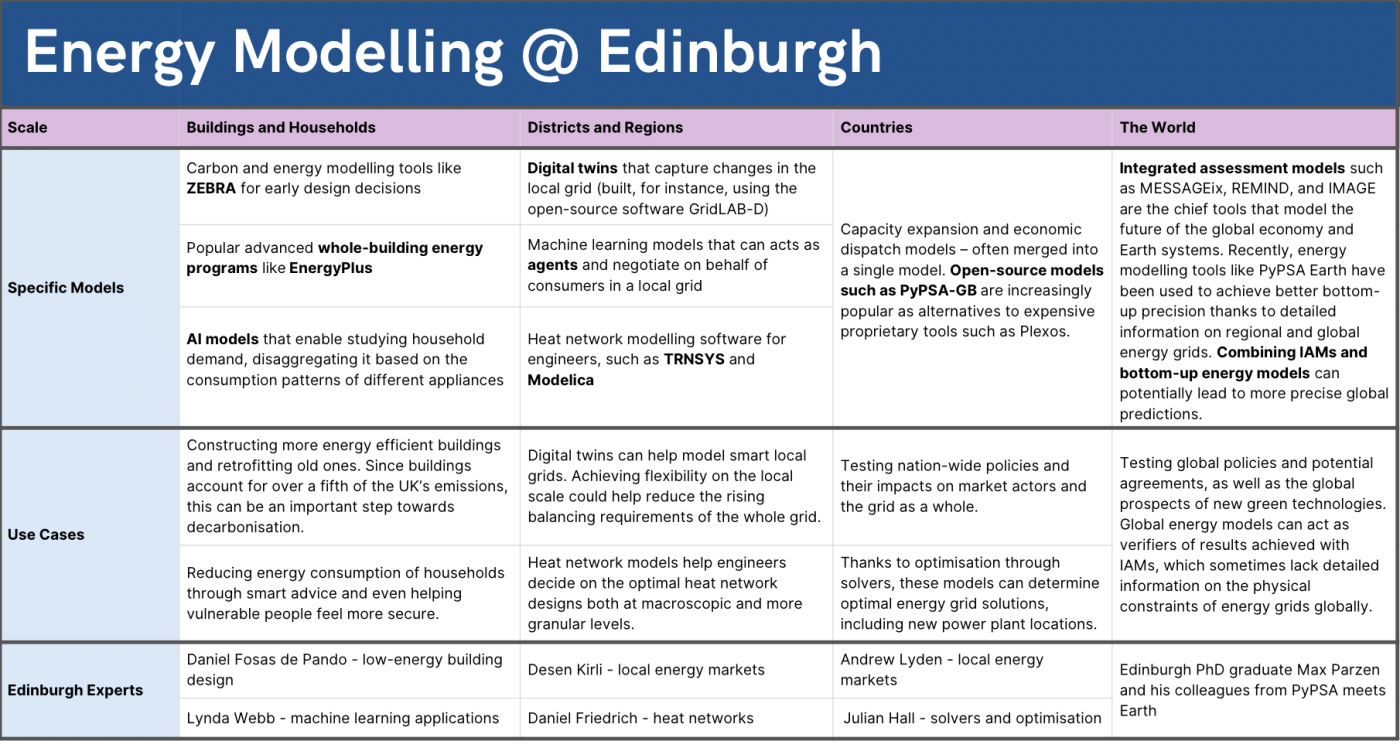
While modelling energy systems is more important than ever, the scales at which different “energy systems” operate vary dramatically: from buildings, districts, and regions to countries and the whole world. Below, you can find examples of tools that support decarbonisation across these scales, helping scientists, governments, NGOs, and businesses make the right decisions in today’s changing world.
Buildings: Energy-Efficient Construction and Retrofitting, Demand Reduction & Life-Saving Applications
According to the UK Government, buildings account for 22% of the country’s greenhouse gas emissions, and the global percentage is even higher. The key challenges are clear: How can we reduce emissions from buildings that have already been built? And how do we construct buildings so that building-related emissions do not increase? Minimising the energy required to maintain comfortable indoor temperatures is the central issue. Energy models consider room sizes, wall thickness and density, building orientation, and window dimensions to calculate the total energy required for heating and cooling. Doing so enables engineers to identify optimal designs that help reduce energy demand.
Modelling can be helpful both when retrofitting old buildings and when designing new ones. Key to achieving high energy performance is getting things right from the early design stages of a new build or retrofit project, argue Daniel Fosas de Pando (now based at the University of Edinburgh) and his colleagues, whose work contributed to nationwide efforts to “revolutionise the way the UK designs, constructs, and operates buildings.” Powerful models are necessary and have historically enabled detailed analyses of buildings’ energy demands, but they have often been too complex for non-specialists. They also required more detailed information or more time to develop than was available in the early stages. As a result, “only a fraction of the modelling capabilities available in the sector has made it into mainstream projects beyond what building regulations ask for,” explains Daniel Fosas. According to US government data, only around one-fifth of new buildings in the United States incorporated similar modelling into the design process at the turn of the decade.
New tools such as ZEBRA aim to address this. The modelling software, developed by researchers at the University of Bath and the University of Edinburgh, makes designing energy-efficient buildings more accessible and straightforward, especially for those without extensive experience in low-energy building modelling. “The tool enables engineers to quickly explore design trade-offs from the outset of a project,” says Dr Fosas. “It supports the transition to net zero by encouraging a wider share of professionals and the next generation of engineers and architects to engage with the building physics most relevant to low-energy buildings,” he adds.
Modelling as Humanitarian Aid
Reducing energy use in buildings is only one aspect of building performance. Studying the effects of high temperatures on homes has become increasingly important in light of extreme weather events, including recent heatwaves, which broke the UK’s record for the most days with temperatures above 34 degrees Celsius in a single year. Modelling remains key. Tools such as the EnergyPlus building energy simulation engine enable engineers to weigh construction trade-offs and even help debunk misconceptions, including the claim that insulation is the main cause of overheating in low-energy homes.
While the impacts of high temperatures in the UK remain serious, Dr Fosas points out that “other parts of the world are routinely exposed to longer periods of even higher temperatures,” often accompanied by high humidity, which makes withstanding extreme heat even more challenging. To address this problem, researchers at Edinburgh, Bath, and Oxford are working with CARE International UK, a non-governmental organisation operating in over 120 countries, to equip the NGO with modelling tools to help prevent overheating in shelters. The SCALA (Sustainable Cooling Approaches for Displaced Populations) project focuses on 10 countries, developing case studies and guidelines to support cooling strategies in both dry and humid climates.
Reduction of Household Demand & AI Models
Building architecture is not the only consideration when reducing energy use in buildings. As Nigel Goddard stated in his interview for Energy at Edinburgh, machine learning can play a key role in reducing people’s energy consumption, offering yet another way in which models – in this case, those based on neural networks – can help lower household energy demand: “We gave every household a tablet and designed an interface for them to look at how their energy was being used. We would give them suggestions on, for example, what sort of wash cycles they were using in their washing machine and suggest to them that perhaps they didn't need to run at such a high temperature, or if they weren’t spinning, that it’s a lot cheaper to spin the water out of the clothes than it is to tumble dry it out,” explains the scientist.
The IDEAL project described above involved 250 UK households and highlights the University of Edinburgh’s long-standing expertise in reducing household demand. The AI model used in the project, which analyses smart meter data to determine appliance usage, has since found another surprising application: helping to save lives. Alongside Edinburgh scientist Lynda Webb, Dr Goddard collaborated with Blackwood Homes and Care to alert relatives of vulnerable people when they were not using their everyday appliances. “We actually had one real-life incident where one of the participants had a medical event that left her unable to respond, move or do her normal things. Our system kicked in and tried to contact her, but couldn’t. It contacted her responder, who went around and found that she needed medical attention. She was fine in the end, but it was a matter of a few hours from when this thing happened to when the medical attention got to her – if that system hadn’t been there, it could have been days,” adds Dr Goddard.
Regions: Reducing Energy Prices for Communities & Making Use of Curtailed Wind through District Heating Networks
Making buildings less energy-intensive reduces demand at the level of individual units in the energy system. But much decarbonisation can also come from changing how those units interact – for instance, by sharing energy. This raises one of the most important questions in the field: can local energy systems make demand as flexible as the variable supply from renewables? If so, the UK could use local systems to partially balance electricity supply and demand, reducing the cost of national system balancing and the curtailment of renewable generation. A great deal of current research focuses on how to achieve this.
One such scientific project, called CARE (Community-led Affordability and Residential Energy Equity), is studying how similar flexibility could be achieved in social housing in Orkney: “We created a digital assistant. You tell it that you have, say, an oven and a washing machine, and you also tell us how you use them. It models the area’s renewable energy generation, as well as congestion and other factors, and asks: ‘Would you be able to shift your demand from this time to another?’” explains Edinburgh scientist Desen Kirli, who is involved in the project. The goal is clear: to reduce pressure on the local grid and save consumers money, which in turn benefits the national energy system.
“Digital Twins”, Communities, and Small Businesses
By modelling regional grids, scientists can help small businesses generate profit while simultaneously assisting local authorities, as Dr Kirli’s team did in Aberdeenshire: “We modelled an interesting part of the network. The distribution network operator knew the area was constrained, but residents were also interested in taking up EVs, heat pumps, and other devices that would increase energy demand to a level requiring very costly upgrades. They commissioned us to model the network in a very representative way, and then calculate projections for 2030, 2050, and beyond. We were asked to identify the year when they would need to upgrade the network, and to model and trial whether a flexible system for end users and their assets would help extend that time. We were able to verify that this was the case.”
The successful project, in which the Edinburgh scientist collaborated with a small company called SCENE (Social Enterprise for Local Energy Futures), involved so-called “digital twins” – models of the network that are continuously updated and capture changes over time: “A digital twin is not just a snapshot in time. We’re able to validate these models and their operations with historic data to show that they’re not just crude models but digital replica representations. Hence, we call them digital twins,” says Desen Kirli. In this specific case, scientists used open-source software called GridLAB-D and combined power-flow modelling with data-driven asset and demand optimisation modelling – an approach that has proven helpful to many different local decision-makers around the country. Flexibility modelling has become a socially oriented service that scientists like Desen Kirli are happy to provide: “If someone has an energy systems problem, they can come to us,” she adds.
Local Energy Markets & Tackling Fuel Poverty
One of the most serious energy-related problems in the UK is fuel poverty, which NEA (National Energy Action) definesas a situation in which a household needs to spend 10% or more of its income on heating. While centralised energy price caps and relief programmes help, much progress could be achieved by enabling residents to trade electricity with each other within their local networks. Edinburgh have explored this through another type of modelling: electricity market modelling. In a local-markets-focused project, Edinburgh’s Daniel Friedrich, Nigel Goddard, Desen Kirli, and their colleagues modelled how price negotiations within a community of 200 UK households could be automated, using virtual agents negotiating on behalf of residents. If people with small renewable resources were enabled to sell some of their electricity, electricity costs would fall not only for them but also for their energy-poor neighbours – by up to 25% on average.
Setting up similar smart electricity markets – such as those in which people with electric cars can get paid for having these vehicles plugged in to help supply electricity during storms, or where consumers agree to charge their EVs to help the grid in exchange for financial remuneration – requires modelling expertise. Collaborations between scientists, small businesses, and local authorities can support local economic growth while helping decarbonise the energy system.
Decarbonising Heating & the Unintended Potential of Data Centres
When it comes to fuel poverty, the key question is: why does heating in the UK become so expensive during fuel crises? According to the Energy & Climate Intelligence Unit, gas is the main culprit. In the European Union, natural gas accounts for just 30–40% of the energy used to heat homes. In the UK, 85% of households used gas to heat their homes in 2022. The UK also lags behind Scandinavia in the uptake of heat pumps and generally relies far more on individual household heating than Central and Eastern Europe, where district heating networks are more common. As a result, heating accounted for around half of total energy consumption in Scotland at the turn of the decade, and a fifth of its greenhouse gas emissions.
Electrifying heating is one of the most important steps towards net zero. Much of this electrification can be achieved at the scale of multiple buildings and even districts. To ensure upgrades are sustainable and well designed, engineers can first model various solutions and then select the most suitable one. In July 2024, Edinburgh scientists Daniel Friedrich and Thibaut Desguers did exactly that. Using the TRNSYS simulation program, they showed how a heat plant with an underground heat battery could replace fossil-fuel-based heating of Edinburgh’s King’s Buildings campus. Similar higher-level thermal modelling can assist local decision-makers: “In Scotland, we have so-called local heat and energy efficiency strategies (LHEES). Every council needs to do zoning and planning,” explains Professor Friedrich. “We are planning to do similar TRNSYS modelling with local community groups and councils to help them with initial decisions. It will help them see if borehole thermal energy storage makes sense in their case,” he adds.
While high-level models like those described above support initial decision-making, more granular models with high temporal resolution help engineers determine the exact form of the heat network they aim to build. Here, another popular software, Modelica, can help: “Modelica planning is slightly further down the line than high-level TRNSYS modelling. You use it to see how to lay out and control the network,” says Daniel Friedrich. However, because the software is more of an equation-based language than a pre-made model, modelling a full network can be complex and time-consuming. Glasgow researcher Orestis Angelidis, Edinburgh’s Daniel Friedrich, and their colleagues have addressed this complexity: thanks to their Modelica FMU – essentially a heat network template model – engineers can now model a 5th-generation district heating and cooling network encompassing multiple buildings. 5th-generation networks operate at low temperatures, with cold and hot water flowing in both directions, enabling multiple buildings with varied needs to share energy. As buildings generate heat, some can act as both sources and end users in these networks, reducing energy losses and improving efficiency. Such modelling remains important for engineers involved in heat network projects, whether in academia or private companies: “These tools are needed. We need to decarbonise heating. We are woefully behind on this,” explains Friedrich.
While investments in sustainable heat network upgrades are often expensive, the Edinburgh Professor doesn’t think they are necessarily uneconomical: “It makes sense if there are waste heat sources. That lowers the price. This becomes really important with data centres and hydrogen, which could potentially produce a lot of waste heat,” he explains. Indeed, Scottish academic discussions have recently turned to so-called “green data centres” – data centres that would use the country’s abundant renewable energy and enable heat recycling. Similar projects, in which heat from computing facilities is planned to be recycled, already exist: The University of Edinburgh’s Advanced Computing Facility could heat at least 5,000 households. Studies are currently underway to determine whether this ambitious goal can be reached.
Countries: Planning Dispatch, Modelling Future Grids & Designing Economies
While the range of energy modelling tools for buildings and regions is wide, the variety of software available to model energy flows across entire countries is even broader. The exact choice of tools depends on the questions being asked, such as: Which plants should be turned on to minimise the cost of electricity needed to meet a country’s demand? What is the total cost of electricity production in a country at a given moment, and what are the resulting greenhouse gas emissions? Or how will a newly built power plant fit into the system? These questions often concern the practicalities of day-to-day energy-system operation – answering them allows for immediate decisions or decisions that will affect the short-term future of the system.
A second class of questions looks into the future: What should the electricity system look like to meet future demand and climate targets? How exactly should the system evolve and what power plants should be built? To answer the former questions, focused on day-to-day practicalities, scientists use so-called Economic Dispatch Models (often also called Production Cost Models). To study more future-oriented problems, engineers and planners often turn to Capacity Expansion Models.
While the two types of models have different names, in reality they can be better understood as two poles of the same spectrum than as unrelated pieces of software. PROMOD is a well-known example of a model that sits close to the Economic Dispatch Model end of the spectrum. However, even models that are closer to the Capacity Expansion end – such as ReEDS, GenX, and E4ST, incorporate a degree of economic dispatch modelling.
High-resolution Modelling of the Future Grid
Recently, models that merge dispatch and capacity expansion capabilities have become increasingly popular. In the UK, consulting companies and public bodies have used them to estimate the economic benefits and trade-offs of reforming the UK’s electricity market. The two main options were either retaining a single wholesale (generator) price of electricity or splitting the UK’s electricity market into zones. During the reform process, Edinburgh’s expert Andrew Lyden commented on available analyses that could have swayed decision-makers either way: “Right now, the debate is driven by consultancy reports – commissioned by Ofgem, Octopus and others – that rely on in-house models. These models involve many assumptions and proprietary data. We’re seeing differences in the projected benefits that come from the zonal pricing option. Specifically, the FTI Consulting report shows very high benefits, compared to the AFRY Management Consulting model, which suggests a much lower benefit.”
While commercial tools such as Plexos are powerful, their results can be difficult to reproduce because access to the software is expensive. Modifying the underlying mathematics and foundational assumptions of similar proprietary models is typically a lengthy process compared with open-source software like that used by Edinburgh scientists, including Dr Lyden: “We offer reproducible and transparent energy modelling. It’s not just a set of results. You can re-run the models and make small changes to them. It’s a package of models, results and reproducibility, rather than a single set of results that are static and only work for one set of assumptions.” One such modelling toolbox is called PyPSA, an open-source, Python-based package that enables analyses similar to those performed with commercial tools. Indeed, Edinburgh’s Lukas Franken weighed in on the debate using a PyPSA-based open-source Edinburgh model GBPower. The researcher showed that the zonal market option could have generated 2 billion more in welfare in the UK than continuing with the existing system. The key contribution of this research was not necessarily the specific figure, but demonstrating that an energy system model capable of performing similar analyses to commercial tools while remaining reproducible and transparent exists. If anyone questioned the study’s underlying assumptions, they could change them and re-run the model thanks to PyPSA’s open-source character.
United Kingdom’s Future
As the UK Government has decided to keep a single wholesale electricity price, designing a modern national market that respects the physical constraints of the electricity grid will require extensive planning and modelling: “Zonal pricing has been rejected, but the conversation hasn’t ended,” explains Andrew Lyden. If the United Kingdom hopes to decarbonise its energy through a functioning decentralised system, new power plants will have to be built in areas with low electricity generation – not just in regions where renewable electricity is already abundant and where investments remain attractive under the national wholesale market. “The key question is: How do we get locational signals into the energy system?” says Dr Lyden, adding that PyPSA-GB, a model that he developed at the University of Edinburgh, can test how various policy incentives would play out both from the perspective of the state and the industrial actors involved.
State and private sector collaborations with scientists have many advantages: “Our main job is never going to be providing short-term solutions for industry. However, we can help maintain and run tools like PyPSA-GB for long periods of time. In consultancies or government bodies, it’s often someone different working on a specific analysis. We can provide longer-term development of solutions, and that’s probably our main strength. We are open to long-term collaborations and offer long-term capability,” says the scientist. Open-source models can be used for problems that require more customisation than commercial models offer, both to verify the results of proprietary tools and to provide preliminary answers to questions that will later be studied using commercial models. Designing the right policies to reach net zero will require identifying where energy system assets should be built, and that’s exactly what models like PyPSA-GB can do transparently.
The World: Energy & The Climate
Modelling energy systems remains important on the largest scale possible – the whole world. The key words that come to mind are “Integrated Assessment Models”. Used to help decision-makers devise climate mitigation and adaptation policies, these models incorporate an understanding of the world’s energy supply and demand. Indeed, energy accounts for somewhere between 40% and over 75% of total global greenhouse gas emissions, depending on the methodology used. Integrated assessment models usually include so-called “modules” on different areas underlying climate change: the global economy, the land system and the climate.
IMAGE, MESSAGEix and REMIND are examples of popular integrated assessment models which incorporate global energy considerations into their design. And while these models are undeniably powerful, “predicted” energy mixes for both baseline and 2°C scenarios for 2100 differ across models even when inputs are identical, as Carbon Brief notes. As the cited report notes, experts have expressed caution about the IAMs’ “optimistic” predictions regarding the extent of deployment of both human-made and biological carbon-negative technologies. Carbon Brief also echoes expert criticismsthat the models may underestimate the prospects of photovoltaic generation.
Modelling the Global Energy System
So, can we make integrated assessment models even more useful than they are today, enabling them to design detailed, possibly country-level energy policies? One potential path might be to connect energy system models like those discussed above with the integrated assessment models mentioned here. While the need to join these two model types into a single model remains debated, scientists worldwide have recently sought to achieve this goal, marking a new direction in energy modelling. Examples include a study that connected PyPSA-Eur with the aforementioned IAM Remind, which focused on energy futures in Germany, and research that combined the capabilities of the GCAM integrated assessment model and PyPSA-BO to study future energy pathways in Bolivia.
Global power system models are required for energy-focused research that aims to capture technologically feasible futures in detail. A few such models already exist, including PLEXOS-World and OSeMOSYS Global. As with country-level open-source modelling, Edinburgh researchers have also made their mark in transparent global energy modelling. Max Parzen, who co-founded and now co-leads Open Energy Transition, founded the PyPSA meets Earth initiative while working towards his PhD at the university: “PyPSA-Earth turns high-level decarbonisation pathways into actionable, regionally tailored insights for energy system planning,” he explains. As a tool that incorporates the physical constraints of energy systems across regions, it offers a level of detail that many integrated assessment models lack. Since PyPSA-Earth’s creation, researchers have used it, for instance, to study energy futures in Africa and the deployment of hydrogen technologies in countries of the Global South. Work on connecting PyPSA with integrated assessment models is underway. As noted by Max Parzen’s colleague Ekaterina Fedotova, a scientific team has already connected PyPSA-Eur and the IAM REMIND to study energy transition pathways in Europe. The next step is to do the same for the whole world.
Final Notes
The modelling approaches described above are only a handful of examples of how modelling can help shape the energy transition. Agent-based, system-dynamics, macroeconomic, and CGE models remain useful to scientific teams worldwide. Many of the higher-level models mentioned above also rely on mathematical optimisation performed by “solvers”. These solvers enable modelling software to identify economically optimal ways to achieve a specific goal, such as where to build a new power plant to match predicted demand. HiGHS is one such solver. Developed by Edinburgh researcher Julian Hall and his team, it is now PyPSA’s default solver.
Regardless of the modelling software used to tackle a specific problem, one thing remains clear: transparent, open-source alternatives to commercial proprietary tools often exist. Scientists remain open to collaboration and ready to contribute actively to the energy transition in the UK and around the world. The hope is that this guide will provide a good starting point for readers interested in learning to model energy systems at different scales, or in finding experts and tools that help with decarbonisation efforts in buildings, regions, countries, and even the whole world.
Author: Jan Žižka